Money is mutating faster than ever. In a matter of years, we’ve moved from physical cash to mobile wallets and now to blockchain-based currencies. As we enter 2026, a new financial world emerges fueled by stablecoins, CBDCs (Central Bank Digital Currencies), and tokenized assets. These changes are not simply technological updates they entail a whole new design for how value flows through the global economy. Together, they’re laying the groundwork for what many believe is the Internet of Money.
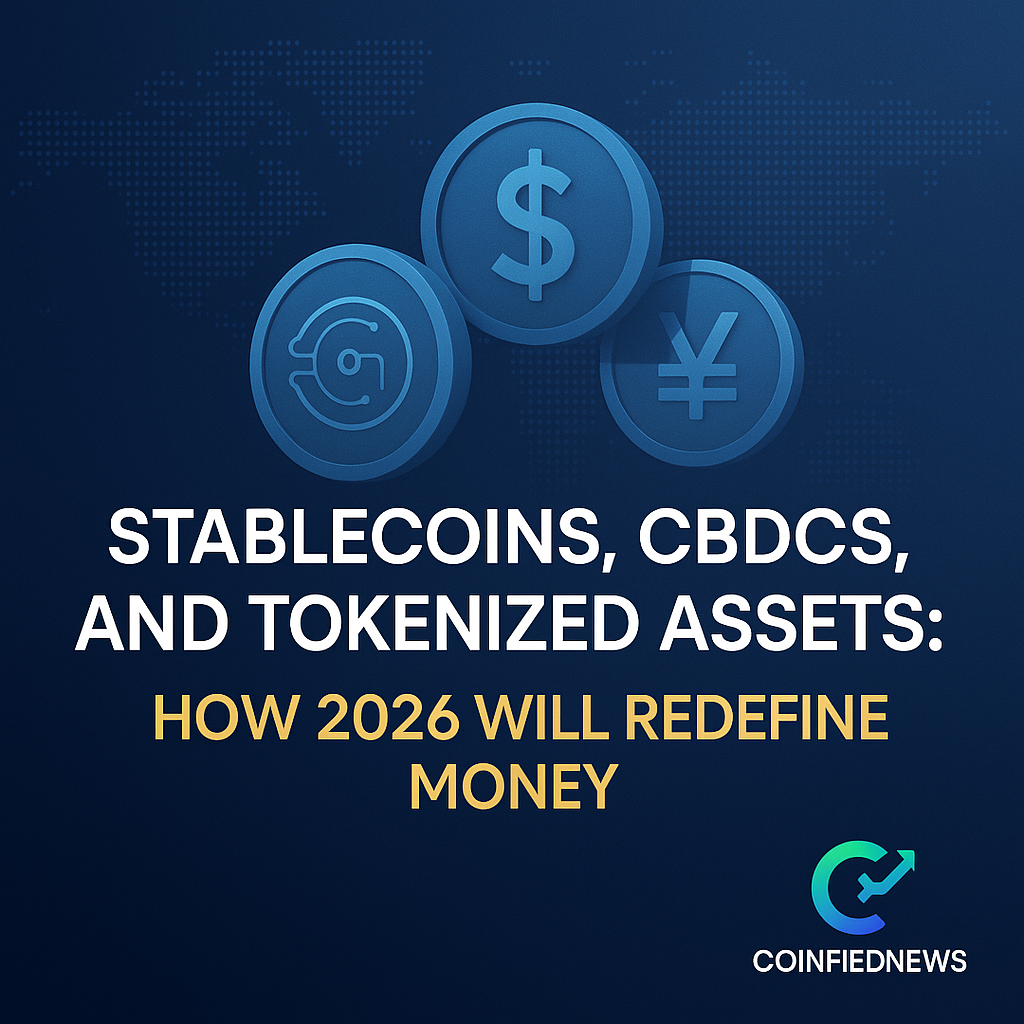
Stablecoins are cryptocurrencies pegged to real-world assets like the U.S. dollar or gold. They were conceived as a solution to one of crypto’s biggest problems: volatility. While Bitcoin and Ethereum’s prices fluctuate, a stablecoin such as USDC, USDT, or DAI remains the same (valued at 1:1 with a fiat currency). That makes them perfect for payments, trading, and cross-border transfers. In 2026, stablecoins have grown beyond the crypto world. Today, many are backed by regulated institutions and audited in real time and have been integrated into global payment systems. You can use them to send remittances, pay for services, or even get your salary in digital dollars. Stablecoins have, in effect, emerged as the gateway for traditional finance into the world of blockchain.
Even as private companies have been developing stablecoins, governments have been working on their own forms of digital money known as Central Bank Digital Currencies or CBDCs. A CBDC is a digital form of a country’s national currency, which would be issued and governed by that nation’s central bank. The idea is straightforward: marrying the stability and confidence of government-backed money with the dynamism and convenience of modern technology. Already leading the way are countries like China (with its digital yuan) and members of the European Union. Over 100 countries are currently testing or deploying CBDCs, more than half of the world’s nations.
For consumers, CBDCs potentially offer near-instantaneous payments, lower fees, and greater availability of banking services. For governments, there is better transparency, less potential for fraud, and greater control over money. Critics, however, worry about privacy. Because CBDCs are fully traceable, they could offer central banks an unprecedented level of visibility into how citizens spend their money. Finding the right balance between convenience and privacy will be one of the critical challenges of digital finance.
Picture owning a sliver of a skyscraper, a painting, or even a sovereign bond all digitally represented on a blockchain and tradable at the click of a button. That’s the power of tokenization. Tokenized assets are real-world assets (RWAs) that are turned into digital tokens, which can be traded and exchanged online. This makes investment a great deal more accessible and liquid. You don’t have to be a millionaire to own real estate you can own, say, 0.1 percent of an office or condo tower as if it were a share of stock. And in 2026, tokenization has moved beyond real estate and art. Governments are toying with tokenized bonds, and companies are selling tokenized shares. Even carbon credits and energy projects are being fractionalized with blockchain. This trend is also bringing global investment opportunities that used to be exclusive to institutions or the rich.
Stablecoins, CBDCs, and tokenized assets aren’t enemies they are part of the new digital financial system. Stablecoins offer liquidity and fast payments. CBDCs provide government supervision and trust. Tokenized assets open up investment and capital markets. Together, they have established an engine of value that operates every bit as seamlessly as the internet value moving just as frictionlessly across borders, 24/7, and with virtually no cost.
The year 2026 is the inflection point for investors. These technologies are changing not just how money works but how wealth is created. The ones who understand digital finance will have a major advantage. A new opportunity could be investing in regulated stablecoins, tokenized funds, or infrastructure powering CBDCs. But caution is also in order. Regulations are still lagging, and not every project will make it. And as always, remember to diversify and do your due diligence.
We are entering a new financial era: one in which money becomes programmable, transparent, and borderless. Stablecoins, CBDCs, and tokenized assets are at the forefront they’re redefining how we pay, invest, and interact with value itself. In 2026, virtual currencies will not be an option they will be the norm. And whether investors or average users, understanding that transformation will be the key to thriving in the next decade of money.
1. What is the main difference between stablecoins and CBDCs?
Stablecoins are issued by private companies and pegged to assets like USD, while CBDCs are government-issued digital currencies.
2. Are stablecoins safe to invest in?
Regulated stablecoins backed by audited reserves are relatively safe, but always check the issuer’s transparency and reputation.
3. How do tokenized assets work?
They represent ownership of real-world assets on a blockchain, allowing fractional investment and easier trading.
4. Will CBDCs replace cash completely?
Not immediately but they may gradually reduce the need for physical currency as adoption grows.